
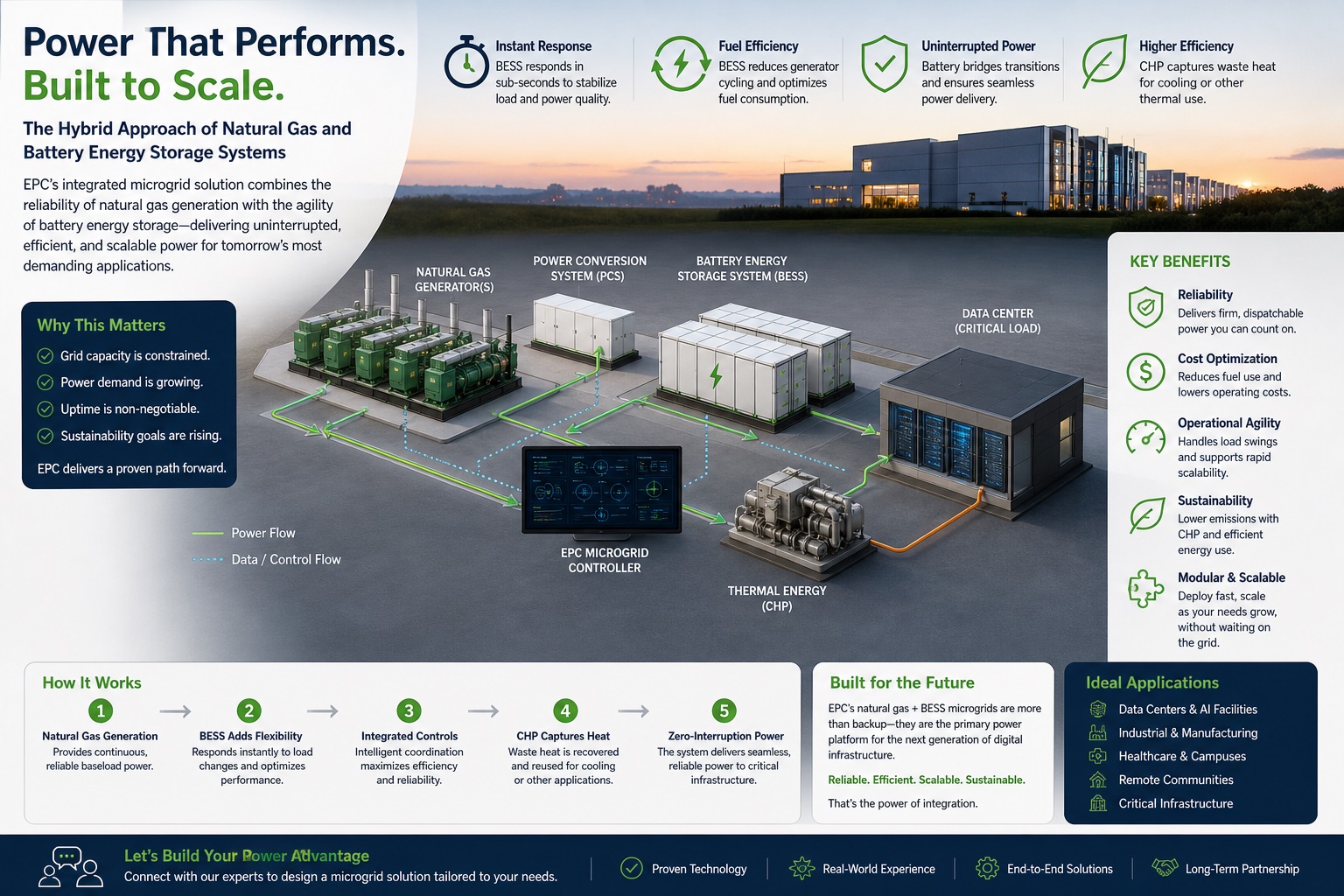
As power demand continues to grow, especially from data centers, traditional grid infrastructure is struggling to keep pace. Long interconnection timelines and increasing uptime requirements are driving a shift toward hybrid microgrids that combine natural gas and battery energy storage systems (BESS).
This approach offers a practical way to deliver reliable, flexible, and scalable power—independent of grid limitations.
How the System Works
At the core of these systems is natural gas generation, which provides firm, dispatchable power. Unlike intermittent resources, gas generators can operate continuously, and ramp as needed, making them well-suited for baseload supply in off-grid or constrained-grid environments.
Layered on top is the battery energy storage system, which adds speed and precision.
With EPC’s high-performance power conversion systems (PCS), BESS can respond in sub-seconds (<100 ms) to load changes—instantly stabilizing voltage and frequency while reducing stress on the generators.
Stability Meets Speed in Practice
Consider a scenario where a data center load jumps from 10 MW to 18 MW within seconds:
- The battery responds instantly
- Generators ramp up in the background
- Power remains stable
- No interruption occurs
This coordination between generation and EPC’s turnkey BESS enables true zero-interruption performance.
More Than Backup Power
A key advantage of EPC’s approach is its fully integrated microgrid architecture. Rather than operating as separate systems, generation and storage are tightly coordinated.
This enables:
- Seamless generator and battery interaction
- Optimized fuel consumption
- Reduced mechanical stress on equipment
With optional combined heat and power (CHP), waste heat from generators can be reused—boosting total system efficiency to 80–90%.
When Does This Approach Make Sense?
Hybrid natural gas + BESS systems are particularly effective when:
- Grid interconnection timelines exceed 12–24 months
- Uptime is mission-critical
- Load demand is large and continuous
- Speed of deployment is a priority
Trade-Offs to Consider
While highly effective, this approach comes with considerations:
- Dependence on natural gas supply
- Higher upfront capital investment
- Increased system complexity
This makes system design and control strategy critical to long-term performance.
How It Compares
| Solution | Reliability | Deployment Speed | Emissions |
| Grid Only | Medium | Slow | Low |
| Diesel Backup | High | Fast | High |
| Renewable + Storage | Medium | Medium | Very Low |
| Gas + BESS | Very High | Fast | Moderate |
A Better Question to Ask
Rather than asking “Can the grid support this?”, a more relevant question is: “What is the cost of even one minute of downtime?”
For many high-demand operations, the answer makes a strong case for a fully controlled, independent power system.
Built for What’s Next
EPC’s modular microgrid solutions can be deployed quickly—without waiting for utility upgrades—and are compatible with future integration of renewables, renewable natural gas, or hydrogen.
Hybrid natural gas + BESS systems are no longer just backup solutions—they are becoming primary energy platforms for critical infrastructure.
By combining stable generation, fast-response storage, and intelligent controls, EPC delivers a solution that balances reliability, efficiency, and scalability.
Sources:
Review of Combined Heat and Power Technologies , 1999, “CHP systems can deliver energy with efficiencies exceeding 90%”
Methods for Calculating CHP Efficiency, 2026, “Typical effective electric efficiencies for reciprocating engine-based CHP systems range from 70 to 85 percent.”
Combined Heat and Power Plant, 2018, “Combined heat and power (CHP) plants produce simultaneously heat and power leading to a high overall conversion efficiency (>80%) .”