
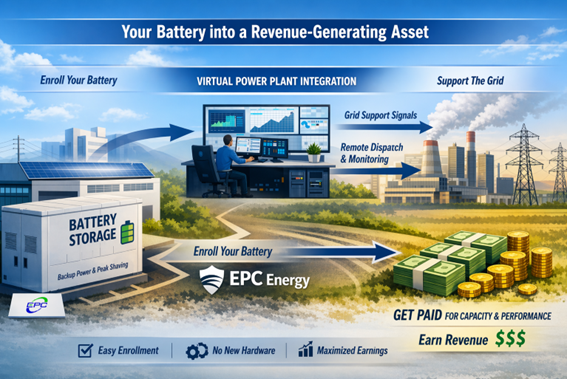
Utilities today are under pressure from sharp peak demand spikes, rapid load growth (driven by EVs, electrification, and data centers), and the variability of renewable energy, all while facing aging infrastructure and slow, expensive grid expansion. On top of that, localized congestion, extreme weather events, and volatile wholesale power prices make it harder to reliably and affordably balance supply and demand. Virtual Power Plants (VPPs) and demand response (DR) programs help relieve these stressors by adding flexible, fast-responding capacity using distributed energy resources, reducing peak load, and deferring the need for costly infrastructure upgrades.
Turn Your Battery into a Revenue-Generating Asset
Battery energy storage systems are typically used for peak shaving, backup power, or demand charge reduction but a lot of their capacity sits unused most of the time. That’s changing with Virtual Power Plants (VPPs) and demand response programs. By enrolling your system with your utility company, your battery can start generating recurring revenue while still doing its primary job. During peak grid events, your system is dispatched to support the grid and you get paid for it. The best part is there’s no new hardware required. If your system has an EMS (or can be integrated with one), it’s likely ready. EPC Energy, as an approved aggregator, handles everything—from enrollment to dispatch to reporting—so you can unlock additional value with minimal effort. During high-stress periods, it’s often faster and cheaper to reduce or shift electricity use than to ramp up additional generation, especially in cases of inadequate power generation. Demand response provides utilities with a flexible, immediate way to balance supply and demand, helping prevent outages, and lower costs.
Demand response programs are especially helpful right now because the power grid is increasingly strained by peak demand spikes and rapid load growth. In particular, electrification trends that require new and often high, simultaneous loads like EV charging and electric heating can significantly increase total demand and create sharper peak periods. At the same time, bottlenecks like congested transmission lines restrict the flow of electricity from where it’s generated to where it’s consumed. When these lines are at capacity, cheaper or cleaner power can’t reach demand centers, forcing reliance on more expensive or less efficient local generation and increasing the risk of overloads or outages.
How the Process Works
We’ve made the enrollment process as simple and low-disruption as possible. It starts with a quick evaluation to confirm your system meets the basic technical requirements—things like communication capability and dispatch readiness. From there, we handle the entire registration process with the utility, including enrollment in programs like SDG&E’s Capacity Bidding Program. Once you’re in, your battery is connected to a secure dispatch platform. When grid events happen, signals are sent automatically and your system responds based on preset parameters. We track performance and calculate revenue based on both availability and actual participation.
As an approved aggregator with SDG&E, we manage everything—enrollment, dispatch coordination, utility compliance, performance reporting, and revenue optimization. You get the benefits of virtual power plant participation without having to navigate complex program rules or maintain direct utility relationships.
What Can You Earn with Virtual Power Plants?
Revenue from VPP participation typically comes in two forms: capacity payments for committing your battery’s availability, and performance payments for actual participation during grid events. For smaller commercial and industrial systems, the numbers can still add up. A 30 kW / 80 kWh system might generate around $3,000–$5,000 per year; a 100 kW / 300 kWh system roughly $10,000–$15,000; and a 180 kW / 532 kWh system somewhere between $18,000–$25,000 annually. A common benchmark is about $100 per kW per year, though actual earnings depend on program structure, availability commitments, and event frequency. Either way, it’s a meaningful uplift in project returns—especially since there’s no additional capital investment required. A few considerations to keep in mind. Participation does require a defined level of availability during certain windows, but those tend to align with normal operations. Dispatch events are infrequent, and controls are set up so backup functionality and on-site priorities stay intact. There may be a slight increase in battery cycling, though it’s generally limited and factored into the overall financial picture. Reliable communication is also essential—systems need to receive and respond to signals in real time.
Why This Matters Now
As the grid becomes more dynamic—with higher renewable penetration and increasing demand variability—utilities are placing greater value on flexible, distributed resources.
Battery storage is uniquely positioned to meet this need. Through VPP participation, your system is no longer just a cost-saving asset—it becomes an active participant in the energy market.
Get Started
If you own or operate a battery energy storage system and are interested in unlocking additional value, now is the time to explore VPP participation.
As a major California utility-approved aggregator, EPC Energy can take care of the entire enrollment process and help you understand exactly what your system can earn.
Interested in seeing your site’s revenue potential?
We can provide a quick estimate based on your system size, usage profile, and operational constraints.