
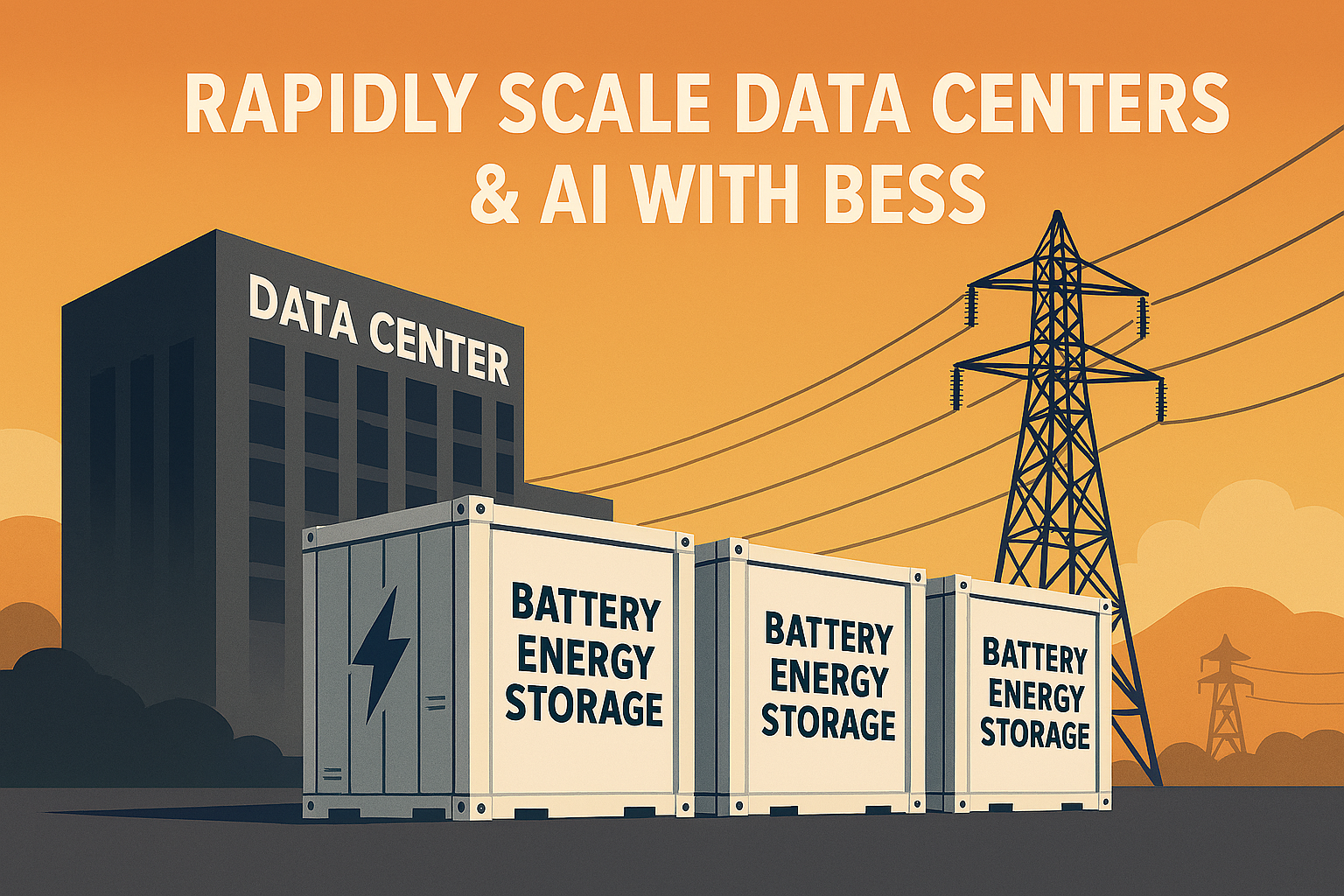
Battery energy storage systems (BESS) are emerging as the fastest way for data centers and AI facilities to scale electrical capacity without waiting years for utility upgrades. While many data centers are intentionally built in regions with affordable electricity, strong transmission access, and ample land, these advantages alone cannot keep pace with the accelerating power demands of AI workloads. Even in high-capacity markets like Virginia, Texas, and Ohio, utilities are facing multi-year delays for new interconnections, transformer shortages, and constrained substations. As a result, BESS is becoming an essential tool for bridging the gap between available grid capacity and the rapid scale-up required for AI and HPC growth. By deploying batteries on-site, operators can meet surging demand, smooth volatile AI workloads, and ensure resilience while bypassing the lengthy permitting and construction timelines tied to traditional grid expansion.
The Challenge: AI and Data Centers Outpacing the Grid
Artificial intelligence workloads are driving unprecedented electricity demand, with U.S. data center consumption projected to quadruple between 2023 and 2030 [1]. Unlike traditional IT loads, AI inference and training cycles create sharp spikes in power usage, stressing utility infrastructure. Waiting years for substation or transmission upgrades is simply incompatible with the pace of AI deployment.
Battery Energy Storage: The Fast-Track Solution
Battery energy storage systems (BESS) provide fast capacity expansion by storing electricity and discharging it during peak demand. Unlike utility upgrades, which require years of planning, batteries can be installed on the timescale of months. Key benefits include:
- Load smoothing for AI workloads: Batteries absorb spikes in demand, preventing costly grid instability.
- Scalable deployment: Systems can start small and expand modularly as AI operations grow.
- Resilience and uptime: Paired with uninterruptible power supply (UPS), batteries safeguard critical operations against outages.
- Grid independence: Facilities can operate without waiting for utility reinforcement, ensuring faster go-to-market timelines.
Applications in Data Centers and AI Facilities
- AI Training Clusters – High-performance computing clusters often require sudden bursts of power. BESS ensures these spikes don’t overwhelm utility service.
- Hyperscale Data Centers – Operators are striking battery storage deals to guarantee reliable operations while fostering growth of the storage market.
- Hybrid Renewable Integration – Batteries allow data centers to pair solar or wind with dispatchable storage, meeting sustainability goals while maintaining reliability.
- National Security & Digital Infrastructure – As AI becomes critical to economic and defense systems, batteries provide a safeguard against grid disruptions.
Why Batteries Beat Utility Upgrades
- Speed: Utility upgrades take years; batteries can be online in months.
- Flexibility: Batteries can be deployed incrementally, matching growth in AI demand.
- Cost Control: By shaving peak loads, batteries reduce demand charges and optimize energy spend.
- Future-Proofing: As AI adoption accelerates, batteries provide a bridge to long-term grid solutions.
Conclusion
Battery energy storage is a strategic enabler of the AI revolution. For data centers racing to scale, batteries provide agility, resilience, and speed that utilities cannot match. By embracing BESS, operators can sidestep grid bottlenecks, ensure uptime, and power the next wave of AI innovation.