
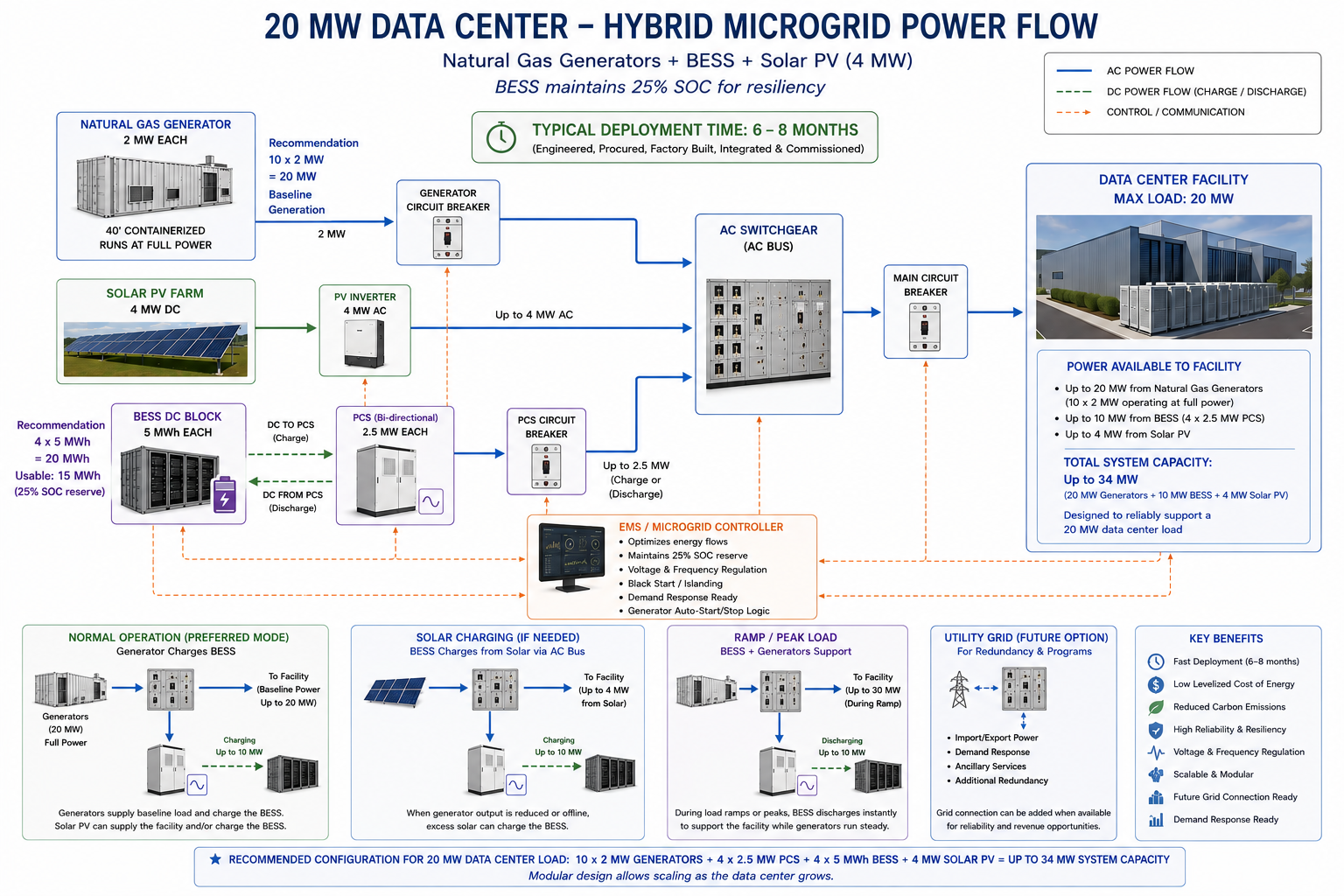
Artificial intelligence, cloud computing, and high-performance computing are driving an unprecedented expansion of data center capacity worldwide. While computing demand continues to accelerate, electrical infrastructure is struggling to keep pace. In many regions, new grid connections require years of planning, permitting, and transmission upgrades before sufficient capacity becomes available.
Why Hybrid Microgrids Are Emerging as the Preferred Baseline Power Solution
For developers who need power today, not years from now; a hybrid microgrid combining natural gas generators with Battery Energy Storage Systems (BESS) offers a compelling alternative.
Rather than relying exclusively on utility interconnections or large centralized power plants, this architecture creates an intelligent on-site energy system capable of delivering reliable, scalable, and lower-emission power while maintaining the flexibility to integrate future renewable energy resources.
A Modern Hybrid Architecture
At the heart of the system is a Battery Energy Storage System coordinated by an advanced Energy Management System (EMS).
A representative building block consists of:
- 2 MW natural gas generator
- 2.5 MW bidirectional Power Conversion System (PCS)
- 5 MWh DC-coupled battery energy storage system
- Intelligent EMS and microgrid controller
- Optional solar PV and wind generation
- Future-ready utility interconnection
This architecture allows the generator and battery to operate together rather than independently.
The generator operates at or near its optimal efficiency point while supplying facility load and charging the battery simultaneously. The battery continuously absorbs and delivers power as conditions change, creating a highly responsive energy system.
Designed Around a 20 MW Data Center
Consider a 20 MW data center consisting of multiple modular power blocks.
Each module contains:
- 2 MW natural gas generator
- 2.5 MW PCS
- 5 MWh battery
The battery maintains approximately 25% state of charge as an operating reserve for resiliency while the remaining capacity is actively used for energy management.
During steady operation:
- Generator supplies continuous baseline power.
- Excess generator output charges the battery.
- EMS maintains reserve capacity automatically.
When compute demand suddenly increases:
The battery instantly responds, supplementing generator output without waiting for engine ramp rates.
One module can provide:
- 2 MW from the generator
- Up to 2.5 MW from the battery
for a combined 4.5 MW of available power during transient or peak demand events.
This enables rapid response to AI training clusters, GPU rack startup, cooling load fluctuations, and other dynamic electrical events without oversizing generation assets.
Faster Deployment Than Traditional Utility Infrastructure
Perhaps the greatest advantage of this architecture is deployment speed.
Many utility-scale interconnections require:
- Transmission studies
- Substation upgrades
- Long permitting timelines
- Transformer manufacturing
- Utility construction schedules
These projects frequently require two to five years, and in constrained markets can take even longer.
A modular natural gas plus BESS system can typically be delivered in approximately six months including:
- Factory-built generator packages
- Containerized battery systems
- Factory-tested PCS equipment
- Integrated controls
Developers can begin operating revenue-generating compute infrastructure years earlier while retaining the option to connect to the utility grid later.
For many AI projects, accelerating commercial operation by even several months can represent millions of dollars in additional revenue.
Why Batteries Change Everything
Without battery storage, generators must constantly chase changing facility loads.
This creates:
- Lower fuel efficiency
- Increased engine wear
- Higher emissions
- Poor transient response
- More frequent maintenance
Adding battery storage fundamentally changes generator operation.
The BESS absorbs rapid load changes while allowing generators to operate in their highest efficiency range.
Benefits include:
- Improved fuel efficiency
- Reduced engine cycling
- Longer maintenance intervals
- Better voltage stability
- Improved frequency stability
- Faster response to transient loads
- Greater overall system reliability
Instead of the generators responding every second, the battery becomes the fast-acting buffer while generators provide economical long-duration energy.
Lower Carbon Emissions Without Sacrificing Reliability
Natural gas remains one of the lowest-carbon fossil fuel generation options available today.
When paired with battery storage, emissions can be reduced further because generators spend more time operating near their optimal efficiency point.
Additional reductions can be achieved through optional renewable generation.
The same microgrid can seamlessly integrate:
- Solar photovoltaic arrays
- Wind turbines
- Additional battery capacity
During periods of renewable production:
- Solar and wind reduce generator runtime.
- Excess renewable energy charges the batteries.
- Generator fuel consumption decreases.
- Overall carbon intensity declines.
The EMS automatically determines the most economical and lowest-emission operating strategy without affecting data center uptime.
As renewable generation is expanded over time, the site’s carbon footprint continues to decrease without requiring significant redesign of the core electrical infrastructure.
Future Utility Connection Without Redesign
A major advantage of this architecture is flexibility.
The data center does not have to choose between off-grid generation and utility power.
Instead, the site can begin operation using the hybrid microgrid and later add a utility interconnection when it becomes available.
Once connected, the system can:
- Operate grid-connected
- Island automatically during outages
- Import or export power as economics dictate
- Participate in demand response programs
- Provide ancillary grid services where market rules allow
- Reduce utility demand charges
- Increase overall site resiliency
The battery becomes the central energy hub coordinating every available energy resource.
Financial Benefits Beyond Backup Power
Unlike traditional standby generators that remain idle most of the year, a hybrid generator-plus-BESS system is an actively managed energy asset.
Potential economic benefits include:
- Accelerated project deployment
- Earlier revenue generation
- Reduced fuel consumption
- Lower maintenance costs
- Reduced generator sizing requirements
- Improved equipment life
- Deferred utility infrastructure costs
- Future demand response revenues
- Potential participation in frequency regulation and other grid support programs where permitted
- Improved energy cost optimization through intelligent dispatch
The battery performs multiple value streams simultaneously, increasing overall return on investment.
A Modular Platform That Grows With Demand
The modular nature of this architecture makes expansion straightforward.
Need another 20 MW?
Simply add additional standardized power blocks.
Need more runtime?
Increase battery capacity.
Need lower emissions?
Add more solar or wind.
Need utility redundancy?
Connect to the grid later.
Each component builds upon the existing microgrid without requiring major redesign.
This flexibility reduces project risk while allowing infrastructure investment to closely follow compute demand.
The Intelligent Microgrid Advantage
The real innovation is not simply combining generators and batteries.
It is the intelligent coordination of every energy resource through an advanced EMS.
The battery serves as the heart of the microgrid by continuously balancing generation, storage, renewable production, and facility demand.
The result is a power system that delivers:
- Fast deployment
- High reliability
- Excellent power quality
- Lower operating costs
- Reduced emissions
- Future scalability
- Grid-ready flexibility
- Improved resiliency
- Optimized generator performance
For today’s rapidly expanding AI and hyperscale data centers, this hybrid architecture provides a practical path to reliable power—months or even years before conventional utility infrastructure can often be delivered.
Conclusion
As electrical demand continues to outpace utility expansion, data center developers need solutions that prioritize speed, flexibility, and long-term economics without compromising reliability.
A modular natural gas and battery energy storage microgrid offers a compelling answer. It enables projects to begin operations in months instead of years, supports rapidly changing AI workloads, integrates renewable energy over time, and positions facilities for future grid participation when interconnections become available.
With the Battery Energy Storage System acting as the intelligent core of the microgrid, operators gain a resilient, efficient, and future-ready energy platform capable of adapting as technology, market opportunities, and sustainability goals continue to evolve.
Baseline Power Solution Comparison
| Criteria | Natural Gas + BESS | Grid Only | Diesel Backup | SMRs | Hydrogen Fuel Cells | Fuel Cells + BESS |
| Typical Deployment Time | 6–8 months | 2–7+ years | 6–12 months | 8–15+ years | 12–24 months | 9–18 months |
| Approximate LCOE (USD/MWh) | $70–110 | $80–180* | $250–450 | $90–160 (projected) | $180–350 | $90–140 |
| Scalability | Excellent | Limited by grid capacity | Good | Excellent | Good | Excellent |
| Power Quality | Excellent | Utility dependent | Fair | Excellent | Excellent | Excellent |
| Dynamic Load Response | Excellent | Good | Fair | Moderate | Moderate | Excellent (with BESS) |
| Peak Power Capability | Generator + BESS operate simultaneously | Utility limited | Limited | Limited | Limited | Fuel Cell + BESS operate simultaneously |
| Renewable Integration | Excellent | Utility dependent | Poor | Moderate | Excellent | Excellent |
| Carbon Emissions | Moderate-Low | Utility dependent | High | Very Low | Very Low (green H₂) | Low |
| Fuel Efficiency | 40–50% overall (higher effective efficiency with BESS optimization) | N/A | 30–40% | 30–40% electric | 45–60% | 60–65% electrical efficiency |
| Reliability / Resiliency | Excellent | Poor without backup | Excellent | Excellent | Excellent | Excellent |
| Maintenance | Moderate | Low | High | Specialized | Moderate | Moderate |
| Footprint | Moderate | Very Low on-site | Moderate | Very Large | Large | Small–Moderate |
| Utility Interconnection / AHJ Approval Difficulty | Moderate | High (utility studies, transmission, substation upgrades) | Moderate | Very High | High | Moderate–High |
| Demand Response Ready | Yes | Yes | Limited | Yes | Yes | Yes |
| Future Grid Connection | Yes | Existing | Possible | Yes | Yes | Yes |
| Best Application | Fast deployment AI & hyperscale data centers | Existing utility-served campuses | Emergency backup only | Future utility-scale generation | Zero-carbon projects | High-availability data centers |