
As demand for AI, cloud computing, and hyperscale infrastructure accelerate, data centers face a critical challenge: securing reliable, scalable power. Despite record-breaking growth in U.S. electric generation capacity, meeting this demand remains difficult. The U.S. Energy Information Administration (EIA) projects that 86 gigawatts (GW) of new capacity will be added to the grid in 2026. At the same time, battery storage capacity has expanded rapidly in recent years and is expected to continue growing.
Even with this surge, traditional grid interconnection timelines are often too slow to support rapid deployment. Meanwhile, renewable-only solutions can struggle to meet the stringent uptime requirements of modern data centers. As a result, natural gas generator (NGG) systems are emerging as a key enabler of new developments. By providing dispatchable, on-demand power, NGG allows operators to bypass grid constraints and bring facilities online more quickly.
From a financial perspective, NGG also offers compelling advantages. Traditional grid-supplied electricity often comes with high transmission fees and demand charges that drive up operating costs. In contrast, the United States benefits from some of the lowest natural gas prices globally, supported by strong domestic production and abundant reserves. These favorable economics make on-site natural gas generation an increasingly attractive and reliable power source for expanding data center operations.
The Hybrid Approach
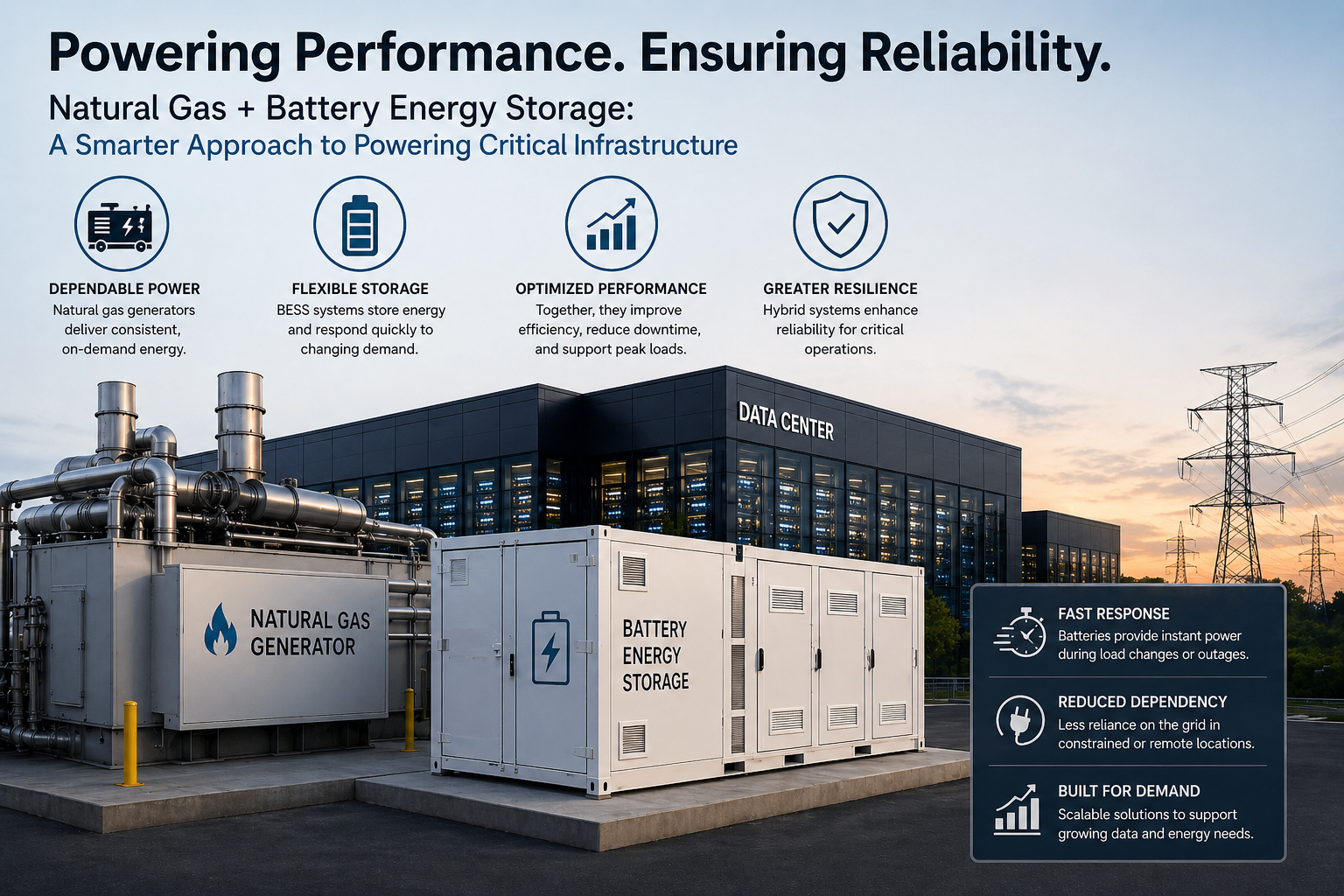
To further improve performance and efficiency, many operators are pairing natural gas generation with battery energy storage systems (BESS). This hybrid approach combines the reliability of generators with the flexibility of energy storage, creating a more resilient and optimized power system while also reducing emissions. It is particularly well suited for critical facilities, projects in grid-constrained regions, and operators seeking greater energy independence.
By integrating these technologies, data centers can establish a more self-sustaining energy platform—one capable of meeting significant and rapidly growing energy demands. Natural gas and battery storage together serve as a practical bridge, supporting expansion today while cleaner energy solutions continue to evolve.
EPC Energy’s standardized 2 MW natural gas generator paired with a 2 MW / 5 MWh battery energy storage system exemplifies this approach. This configuration delivers both firm, dispatchable generation and short-duration energy shifting, enabling peak shaving, load balancing, and backup support within a compact footprint. The system is designed to meet the fast deployment timelines and high-reliability requirements of modern data centers, while offering scalability to support larger campus developments. By packaging generation and storage into a repeatable, modular solution, EPC Energy helps operators reduce engineering complexity, accelerate project schedules, and achieve a more predictable path to energization.
As energy demand surges—especially from data-intensive industries—hybrid systems that pair natural gas with battery storage offer a pragmatic path forward. By blending dependable, on-demand generation with flexible, lower-emission storage, operators can enhance performance, improve resilience, and manage costs more effectively. This approach provides a critical stepping stone, enabling continued growth without compromising reliability. As the energy landscape evolves, such integrated systems will play an essential role in bridging today’s constraints with tomorrow’s infrastructure.